
VIOFO BP60 vs BP100: Which Dash Cam Battery Pack Should You Buy?
Parking mode is supposed to give you peace of mind. Your dash cam can keep recording while your car sits overnight, ready to capture an impact or suspicious activity. But if it draws power from your car’s starter battery, there is always that nagging question: will the car start in the morning?
A dedicated dash cam battery pack tackles that worry by powering the camera from its own cells while you are parked. VIOFO offers two options: the compact BP60 and the higher-capacity, expandable BP100. The right choice depends less on which one looks better on paper and more on your camera setup, your driving routine, and how long you need parking mode to run.
Key Takeaways
- A dedicated pack powers parking mode without drawing from the starter battery while parked.
- The BP60 suits compact daily setups and adds the flexibility of USB-C charging.
- The BP100 offers longer runtime and supports up to two expansion batteries.
- Camera channel count and recording mode can change runtime substantially.
Table of Contents
- Why use a battery pack instead of a hardwire kit?
- VIOFO BP60: The compact choice for daily parking
- VIOFO BP100: More capacity and room to expand
- Installation: Check your 12-volt socket first
- Real-world runtime: Your camera matters as much as the pack
- Which VIOFO battery pack should you choose?
Why use a battery pack instead of a hardwire kit?
A conventional hardwire kit connects to your vehicle’s fuse box. It uses a constant-power connection and an accessory connection so the dash cam knows when the ignition is on or off. Once you park, the camera can switch to motion recording, time-lapse, low-bitrate recording, or impact detection.
That works, but the camera continues drawing from the vehicle’s main battery. Many hardwire kits include a voltage cutoff, which helps prevent excessive discharge. I consider that a fail-safe, not a plan to rely on every day. A recording timer or low-power impact mode can reduce the load, but an ageing battery or an extended stay at an airport can still leave you uneasy.
A dedicated pack changes the power path. While you drive, the vehicle charges the pack through a switched 12-volt socket or a hardwire connection. When you turn the car off, the pack supplies the dash cam for parking mode. Its goal is to keep parked recording from draining the battery you need to start the car.
VIOFO BP60: The compact choice for daily parking
The BP60 is the smaller of the two packs. If space under a seat or elsewhere in the cabin is tight, its size is a real advantage. It uses lithium iron phosphate, often written as LiFePO4, cells, a chemistry chosen for durability and suitability for the temperature demands of a vehicle.
Capacity is 5,000 mAh, or 64 Wh. VIOFO’s estimate is about 20 hours with a dash cam drawing 3 W. Think of that as a useful baseline for overnight coverage, not a promise that every camera will last 20 hours.
What comes with the BP60?
The box includes Velcro mounting strips, a hardwire input cable, a 12-volt socket input cable, a dash cam output cable and fuse taps. You can secure the pack under a seat, in the trunk, or in another suitable spot in the vehicle.
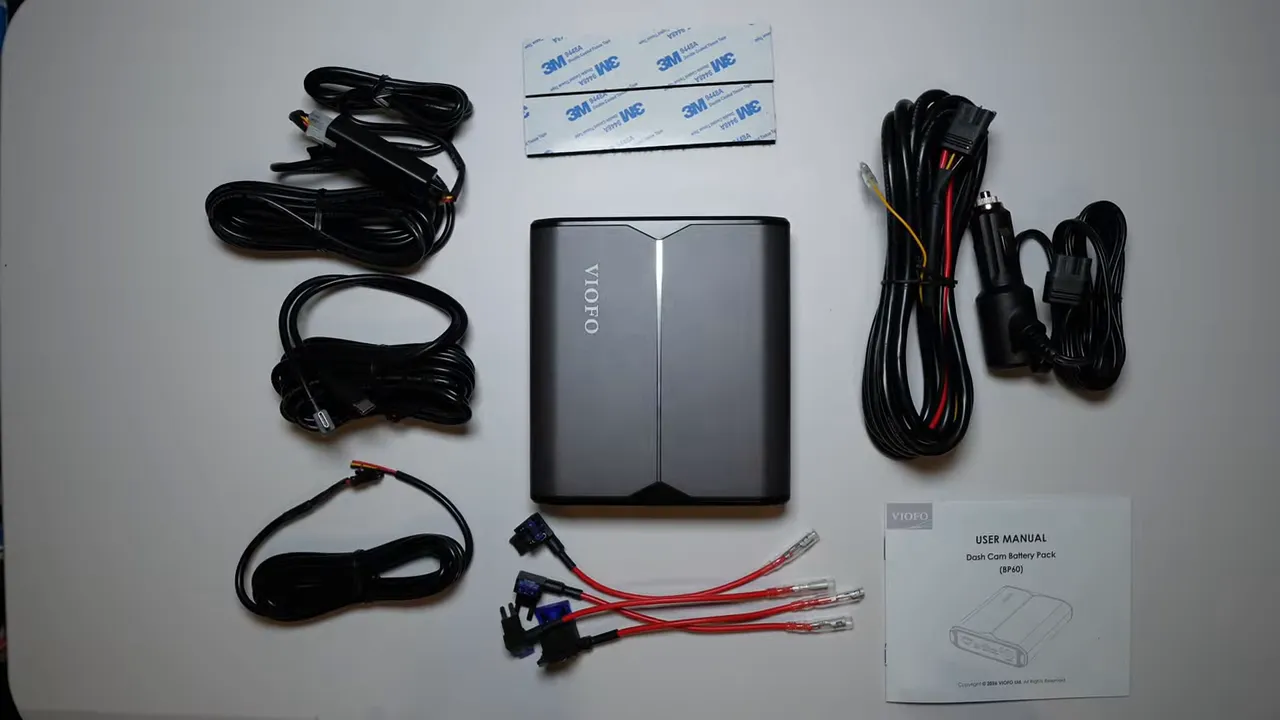
The supplied dash cam output cable is the one I would use for a VIOFO installation. It means you do not need to buy a separate HK4 or HK6 kit just to connect the camera to the pack. There is also a three-wire output option with power, ground and ignition connections for compatible cameras from other brands, including BlackVue, Thinkware and Vueroid.
One small gripe: although fuse taps are included, you may need additional matching taps or fuses for your particular vehicle and installation. Check your fuse-box requirements before you begin rather than discovering a missing piece halfway through the job.
Charging and monitoring
- Hardwire input: A full charge can take as little as approximately 45 minutes of driving.
- 12-volt socket input: A full charge takes approximately 65 minutes.
- USB-C input: You can charge the BP60 at home in approximately 85 minutes.
That USB-C input is a particularly handy BP60 feature. Its USB-C port can also provide output power, and built-in Bluetooth lets you check charge status and estimated remaining time in the VIOFO app.
VIOFO BP100: More capacity and room to expand
The BP100 is noticeably larger, but you gain a substantial capacity increase: 7,650 mAh, or 98 Wh. It also uses LiFePO4 cells. At a 3 W draw, VIOFO estimates approximately 32 hours of parking-mode power.
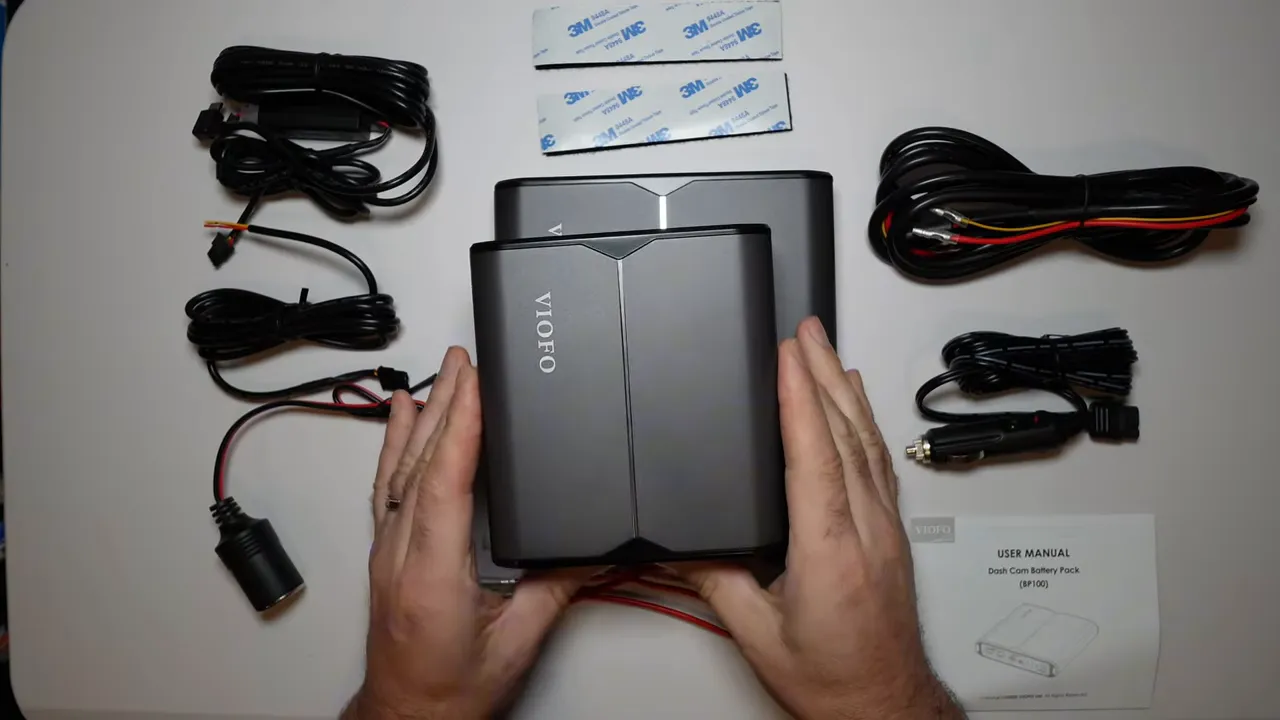
Like the BP60, the BP100 includes mounting strips, hardwire and 12-volt socket input options, an output cable for a VIOFO dash cam, and a three-wire output option for compatible other-brand cameras. It also has a 12-volt socket-style output that can accommodate certain older dash cams powered through that type of plug.
The BP100 has a USB-C output for powering another device, such as a phone, while the dash cam uses its dedicated output. Unlike the BP60, you cannot charge the BP100 through USB-C.
Its larger capacity takes longer to replenish: approximately 70 minutes by hardwire or 100 minutes through the 12-volt socket. Bluetooth monitoring through the VIOFO app provides charge percentage, battery temperature and estimated remaining runtime.
Installation: Check your 12-volt socket first
The simplest installation for either pack is to secure it in the vehicle, plug its input cable into a 12-volt socket, and route the output cable to the dash cam. There is one crucial check: the vehicle’s socket must turn off with the ignition. If it stays powered when the car is off, it defeats the intended separation from your starter battery.
Hardwiring the pack to the vehicle’s electrical system takes more installation work, but it provides the faster charging times listed above. Instead of hardwiring the dash cam directly to the fuse box, you wire the battery pack and connect the camera to its output. With the appropriate connections in place, the pack handles the transition into and out of parking mode automatically.
If you would like a closer look at the installation process, our dash cam installation videos provide additional examples.
Real-world runtime: Your camera matters as much as the pack
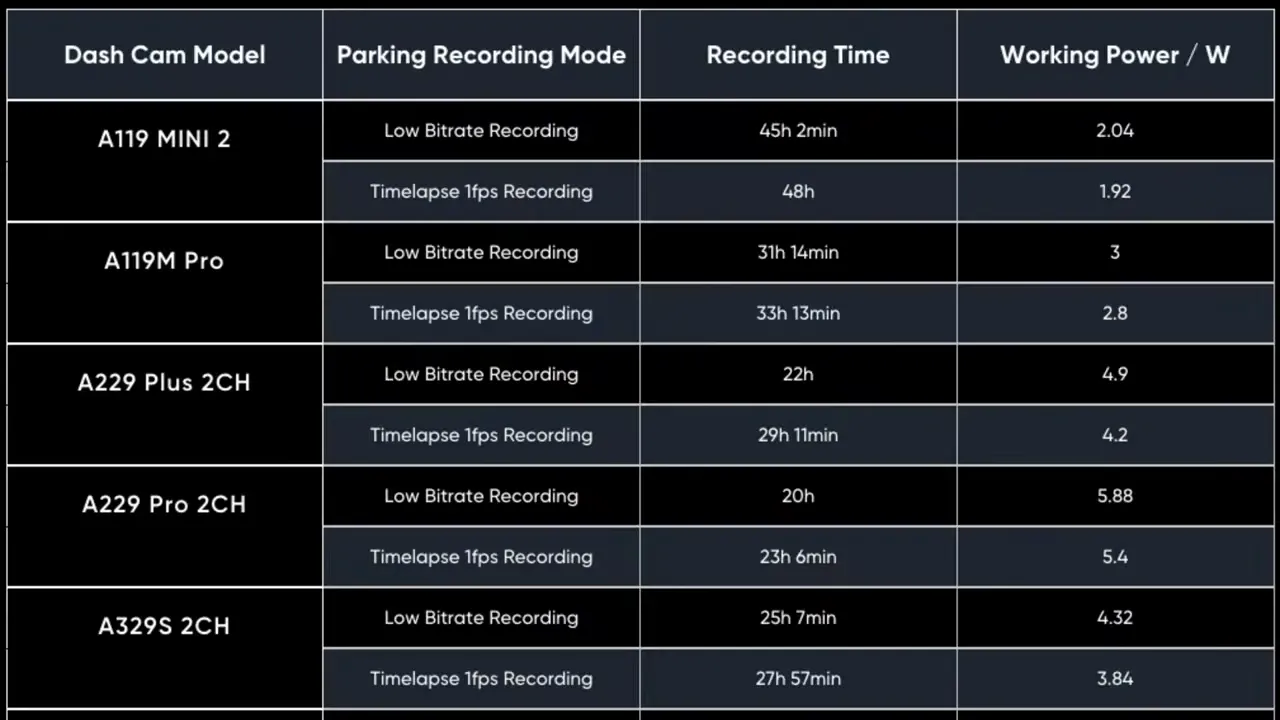
The headline estimates of 20 hours for the BP60 and 32 hours for the BP100 assume a 3 W camera. A front-and-rear system, and especially a three-channel system with an interior camera, uses more power. Recording mode also affects the result.
These approximate low-bitrate parking-mode figures show why it is worth matching the pack to your actual dash cam rather than shopping by battery capacity alone:
| Dash cam configuration | BP60 | BP100 |
|---|---|---|
| VIOFO Mini 2, single channel | About 24 hours | About 45 hours |
| VIOFO A229 Plus, front and rear | About 15 hours | About 22 hours |
| VIOFO A329S, front, rear and interior | A little over 9 hours | About 14 hours and 39 minutes |
These are estimates for a fully charged pack in the stated recording mode. The lesson is clear: adding camera channels can cut parking coverage considerably. A BP60 that comfortably covers an overnight stay with a single camera may be a much tighter fit for a three-channel setup.
Expansion is the BP100’s biggest advantage
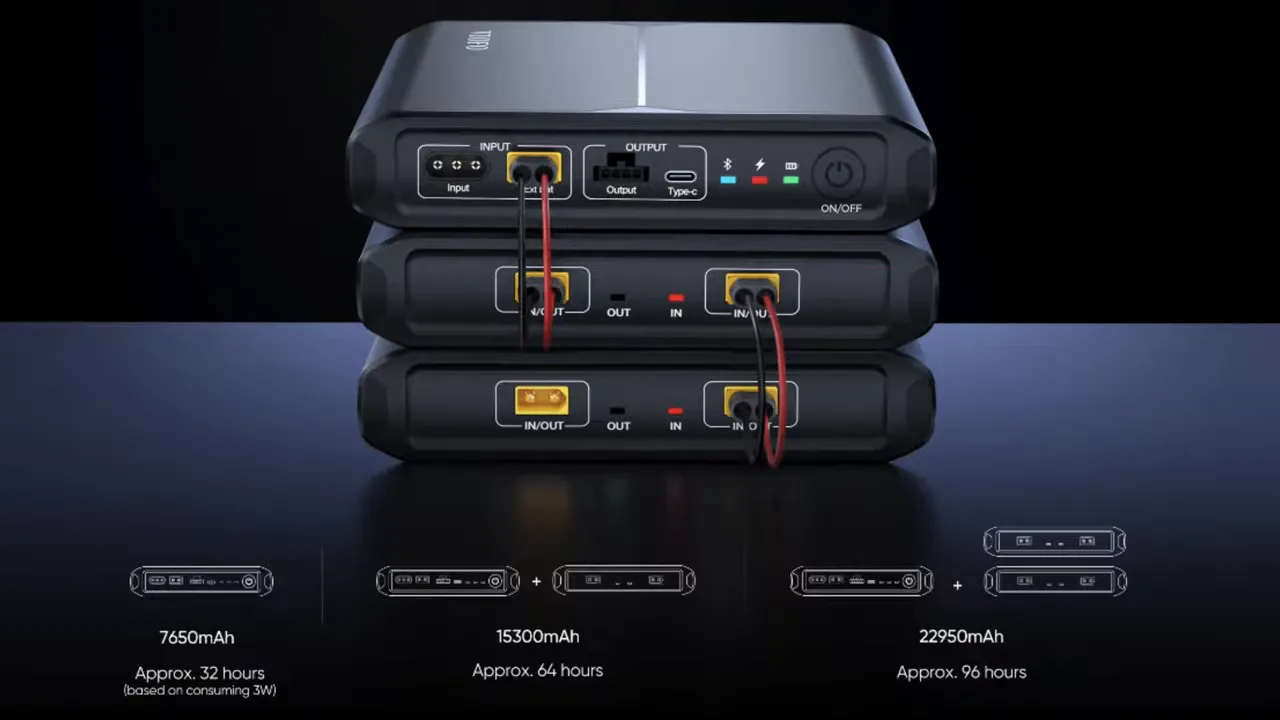
If you regularly leave your car parked for longer stretches, the BP100 can connect to up to two EP100 expansion batteries. Each adds another 98 Wh of capacity, potentially bringing the system to three times the capacity of a BP100 alone. The BP60 is not expandable.
Make the stored power last longer
More battery is not the only way to extend useful coverage. If your compatible VIOFO or Vueroid dash cam supports geofencing, you can set zones where parking mode turns off because you do not need it there. That saves the pack’s charge for places where you do want surveillance.
Compatible models with hybrid parking mode offer another option. Hybrid mode can begin with time-lapse, motion detection, or low-bitrate recording, then switch to low-power impact detection after a set period. It is a sensible way to keep initial coverage while reducing power use later in a long parking session.
Which VIOFO battery pack should you choose?
Choose the BP60 if you want a compact, fit-and-forget solution for daily driving and overnight parking. Its quick hardwire charge time and ability to charge at home over USB-C are especially appealing. It also makes sense if you drive an EV or hybrid and would rather not have parking mode draw from a smaller vehicle battery.
For example, if you drive roughly 45 minutes a day and want coverage through an eight-hour workday, the BP60 is a strong place to start. Just check the expected runtime for your particular camera configuration.
Choose the BP100 if you run a two-, three-, or four-channel setup, park on the street for extended periods, or want the option to add EP100 expansion batteries later. Its capacity makes it the more flexible choice when long parking sessions are a regular part of your routine.
Neither pack is a solution for a car that rarely moves. A battery pack needs an opportunity to recharge, whether that is during driving or, in the BP60’s case, through its USB-C input at home. For straightforward daily protection, I would take the smaller BP60. For longer surveillance and a system that can grow, the BP100 is the clear pick.
|