
What’s New and Exciting in Dash Cameras from SEMA 2026
Some of the most interesting dash cameras at SEMA 2026 weren’t simply chasing higher resolution. They were solving problems customers keep asking us about: recording only the interior, getting a useful rear camera onto a pickup truck, improving parking protection, and downloading footage without pulling out an SD card.
We stopped by DDPAI, Momento, OVAMAN, VUEROID, Vantrue, VIOFO, and BlackVue. There were a few genuine surprises, some promising upgrades, and a couple of specifications I’d want to question before getting too excited.
A number of these products were being previewed for a possible 2027 release. Treat the upcoming models as previews rather than confirmed launch schedules, and remember that a trade-show demonstration isn’t the same as a proper road test.
Key Takeaways
- DDPAI’s 3K interior camera can record independently without a main front camera.
- OVAMAN demonstrated buffered impact recording, but its 4K claim raises sensor-resolution questions.
- VUEROID previewed home Wi-Fi transfers, LTE connectivity, and expanded camera options.
- Several upcoming products remain previews, with release timing and real-world performance still unconfirmed.
Table of Contents
- DDPAI Z100 Master: A Flexible Camera System with a Standalone Interior Option
- Momento M8 Ultra: Radar Parking Mode at Both Ends
- OVAMAN: OEM-Fit Dash Cameras with More Useful Parking Recording
- VUEROID: S1 4K Crown Upgrades, Home Sync, and LTE
- Vantrue: A Truck Camera Prototype and a Compact Battery Pack
- VIOFO Z320: The Surprise Telephoto Dash Camera
- BlackVue Elite 10 Cabin: 4K Front and 4K Interior
- What I’m Most Interested in Testing Next
DDPAI Z100 Master: A Flexible Camera System with a Standalone Interior Option
DDPAI’s Z100 Master brings together several camera options:
- 4K front camera paired with a 2K telephoto camera.
- 4K rear camera.
- Optional 3K interior camera.
That’s an interesting combination, but the interior camera is what really caught my attention. It can operate independently. You don’t have to pair it with the main dash camera to record the cabin.
You can insert an SD card directly into the 3K interior camera and use it on its own. That matters for someone who already has exterior coverage and simply wants to add interior recording. A Tesla owner might fall into that category, as might an Uber or other rideshare driver who wants a dedicated cabin camera.
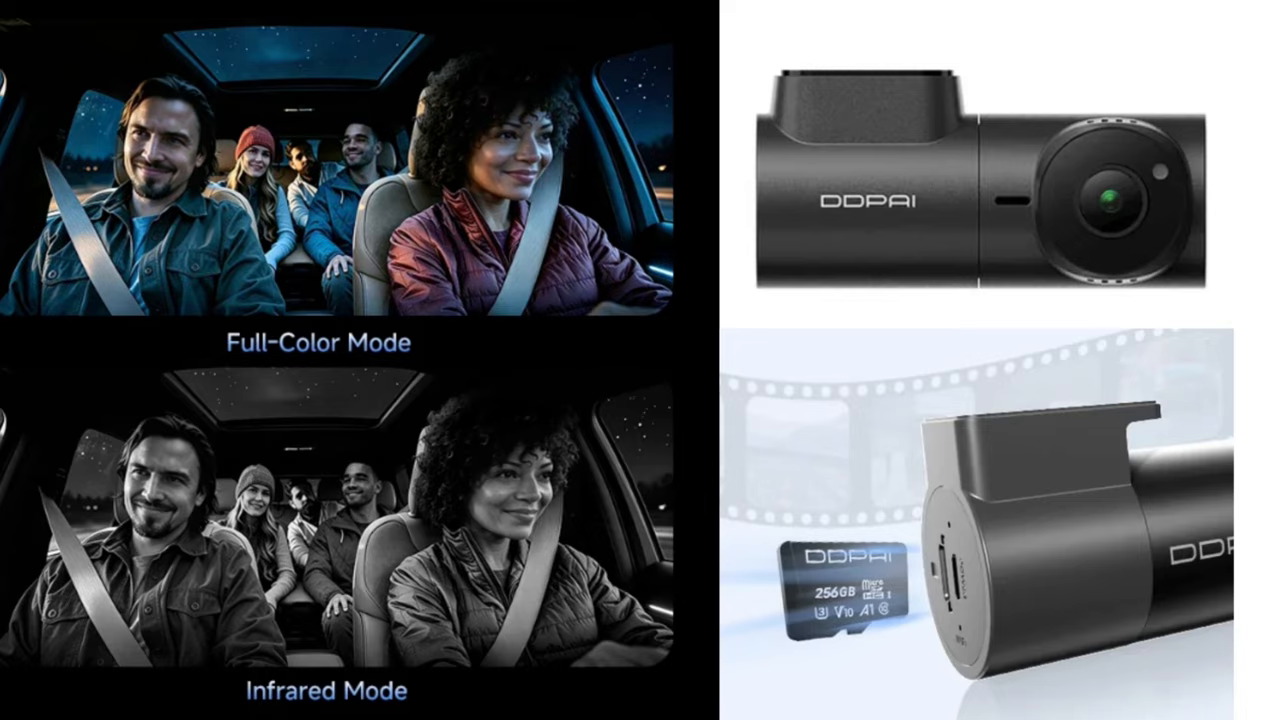
We regularly get questions about interior-only dash cameras. A lot of systems make you buy a main front camera first, even when that isn’t what you need. DDPAI appears to have a practical answer here, and that’s why this little camera stood out more to me than another headline resolution number.
Momento M8 Ultra: Radar Parking Mode at Both Ends
At the Firstech booth, we checked out the Momento M8 Ultra. The front camera uses a 4K Sony STARVIS 2 image sensor with HDR, paired with a 1080p rear camera.
The more interesting detail is that both the front and rear cameras have radar parking mode. That makes this a system I’m particularly interested in testing.
There’s still an important specification missing from my notes: I couldn’t confirm which image sensor Momento is using in the rear camera. Knowing the front sensor doesn’t tell us everything about rear image quality, so that remains an open question.
Sony’s image sensor technology information provides useful background on its security-camera sensor technology, but the finished dash camera still needs to prove itself. For the M8 Ultra, I want to see both the actual footage and how the front and rear radar parking functions perform in practice.
OVAMAN: OEM-Fit Dash Cameras with More Useful Parking Recording
This was OVAMAN’s first time exhibiting at SEMA. Its focus is OEM-fit dash cameras, designed to blend into a vehicle rather than look like a separate accessory stuck to the windshield.
That puts it in the same conversation as Fitcamx. But the parking-mode behaviour is where OVAMAN got my attention.
Time-Lapse Recording with Buffered Impact Events
One of my frustrations with the Fitcamx units I’ve reviewed is that they don’t wake up from an impact while parked. A tidy installation is nice, but I want parking protection that actually captures the event.
OVAMAN described a different approach:
- The camera records in time-lapse while parked.
- If an impact occurs, it retains footage from 10 seconds before the impact.
- It records the event as a normal 30-frames-per-second video file.
The pre-impact footage is the important part. Recording only after something happens can leave you without the context you actually need.
OVAMAN had roughly 60 vehicle applications available at the time of the show. That gives its OEM-fit approach a fairly broad starting point, although the correct application still needs to match the vehicle.
If parking protection is a priority, our guide to choosing a dash camera with parking mode goes further into the differences worth considering.
A 4K Claim That Deserves a Closer Look
My main concern is the resolution claim. OVAMAN was advertising 4K HDR while using the Sony IMX675, which is a 2K image sensor.
That’s a specification I would challenge. A 4K label should not be treated as proof of native 4K capture when the underlying sensor is 2K. Before recommending it on image quality, I’d want to examine the actual recordings and understand exactly what the camera is producing.
A Three-Channel Ford F-150 Mirror System
OVAMAN also demonstrated a vehicle-specific system for the Ford F-150. It replaces the rearview mirror and the rear tailgate camera assembly, with an additional front camera mounted to the windshield.
The replacement mirror acts as the display. You can switch between the different camera views on the screen, and the system records three channels.
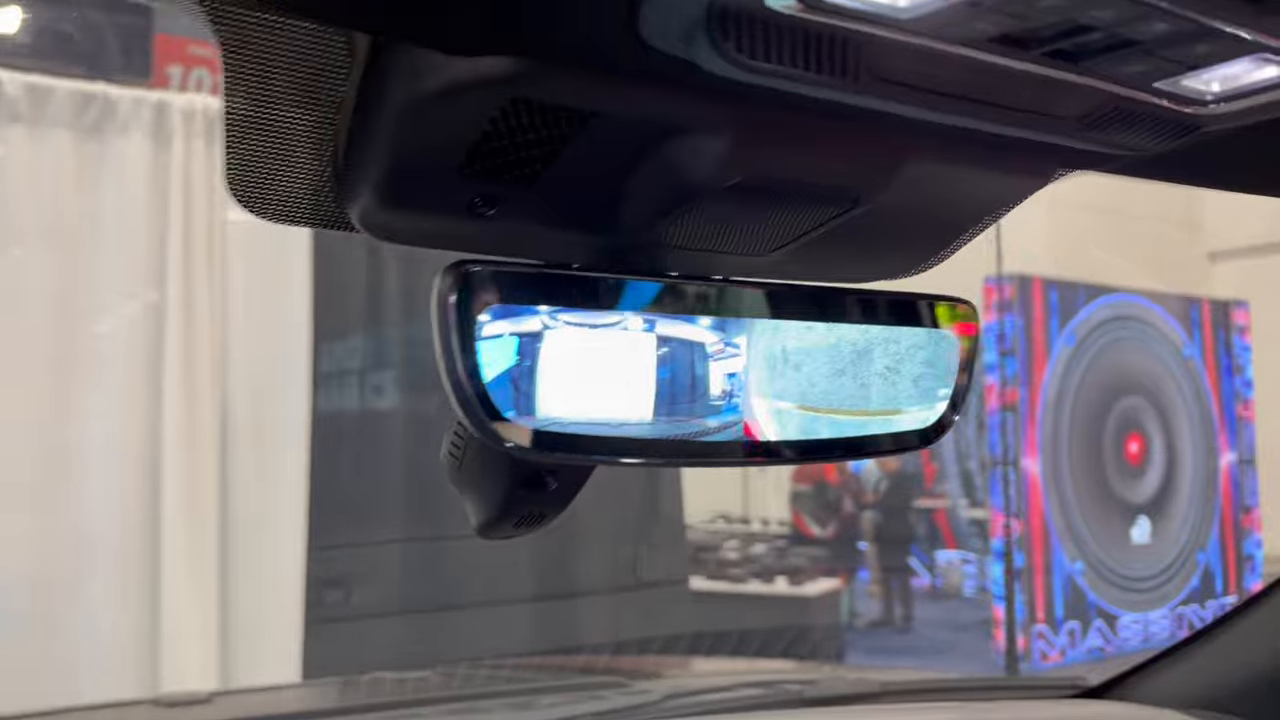
This is an interesting answer for truck owners asking for a direct rear-facing view rather than relying on a camera looking through the cab. The front camera’s appearance wasn’t my favourite, but the overall integration is worth a closer look.
My understanding at the show was that pricing was around US$1,000. That was an approximate figure, not a confirmed final quote.
VUEROID: S1 4K Crown Upgrades, Home Sync, and LTE
VUEROID had quite a bit going on, from upgraded camera options to accessories that change how footage gets transferred and how the camera connects.
S1 4K Crown Adds 2K Interior and Telephoto Options
The S1 4K Crown uses a 4K Sony STARVIS 2 IMX678 front image sensor. The new version supports a 2K interior camera and a 2K telephoto option, moving those additional camera choices beyond 1080p.
There was also a waterproof camera option that integrates with the unit. That broadens the available installation choices beyond conventional cameras mounted inside the vehicle.
There are a couple of physical changes worth noting:
- The rear-camera connection has moved to the side of the main unit.
- The rear-camera input now uses a coaxial connection.
- The interior or telephoto camera connections are at the top.
I’m not particularly excited about the rear connection moving to the side, but the switch to coaxial could make some upgrades easier. An existing cable from a BlackVue or VIOFO A329-series installation may work.
That is a possibility, not confirmed universal compatibility. It’s worth checking the exact cable and camera combination before planning an upgrade around reusing the wiring.
For background on the existing camera, we’ve also covered the VUEROID S1 4K in a separate review.
Home Sync Downloads Footage When You Arrive Home
Home Sync was one of the VUEROID features I was most excited about. The idea is straightforward: pull up at home, connect over Wi-Fi, and have selected videos download to home-based storage.
That could be a useful alternative to manually taking the card out whenever you want to save footage.
VUEROID demonstrated it working, although the transfer was slow inside the Las Vegas Convention Center. I wouldn’t use that demonstration alone to judge its real-world transfer speed. It showed the function operating, but it didn’t establish how quickly it will work in a normal home setup.
VUEROID Air Adds an LTE Connection
VUEROID Air is an LTE module that creates a hotspot for the dash camera. The camera communicates with that hotspot to gain LTE connectivity.
It’s a separate accessory approach rather than a reason to assume every camera has an LTE modem built in. The demonstration established the connection concept, but it wasn’t enough to assess all the connected features in everyday use.
H1 QHD and H1 4K Crown
VUEROID also showed two front-only models: the H1 QHD at 2K and the H1 4K Crown at 4K.
If you want parking mode with these cameras, you’ll need the USB-C hardwire cable. That’s an important installation detail to account for rather than assuming the basic power connection covers every function.
Vantrue: A Truck Camera Prototype and a Compact Battery Pack
Vantrue didn’t have a huge number of new products, but two items were worth stopping for: a rear-camera prototype for trucks and a small dash camera battery pack.
A Rear Camera That Plugs into the Back of a Truck
The prototype is designed to plug into the rear connection area of a truck. Vantrue demonstrated the concept on a Ford F-150.
I can see the appeal. Adding a useful rear dash camera to a pickup isn’t always as straightforward as installing one in a car, and this offers a different mounting approach.
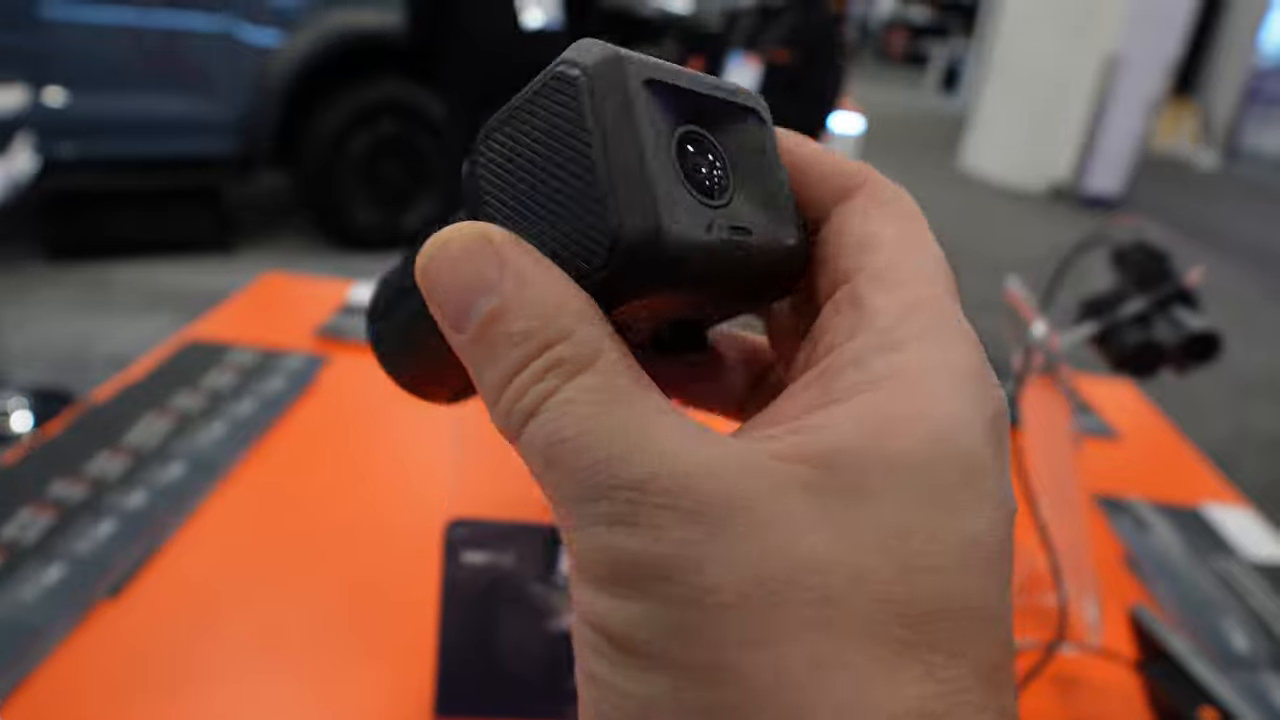
But I have questions. Could someone steal it easily? How well will it work in that location? And is somebody going to step on it?
It’s an interesting concept, but those practical concerns need answers before I’d call it a finished solution. This was a prototype, and that distinction matters.
A 10,000 mAh Battery with Three-Wire Support
Vantrue’s new battery pack is rated at 10,000 mAh and is quite small physically.
The feature I like is support for a three-wire hardwire connection. Its DC output is intended to work with dash cameras that use a three-wire hardwire cable, giving it potential beyond Vantrue’s own cameras.
That flexibility is useful, but the capacity figure alone doesn’t establish parking-recording runtime. We didn’t conduct a runtime test at the booth, so I’m not putting an hours-of-coverage number on it.
VIOFO Z320: The Surprise Telephoto Dash Camera
VIOFO managed to sneak one past us. I usually have a pretty good idea of the products it’s working on, but the Z320 was a surprise. As soon as we arrived at the booth, the team brought us straight over to it.
The Z320 is a three-channel system with two cameras in one main chassis, including a telephoto camera. The telephoto specification shown was 4× optical zoom at 2K resolution.
It also has a full touchscreen. The demonstration included access to Wi-Fi, switching HDR on or off, and displaying the three camera channels.
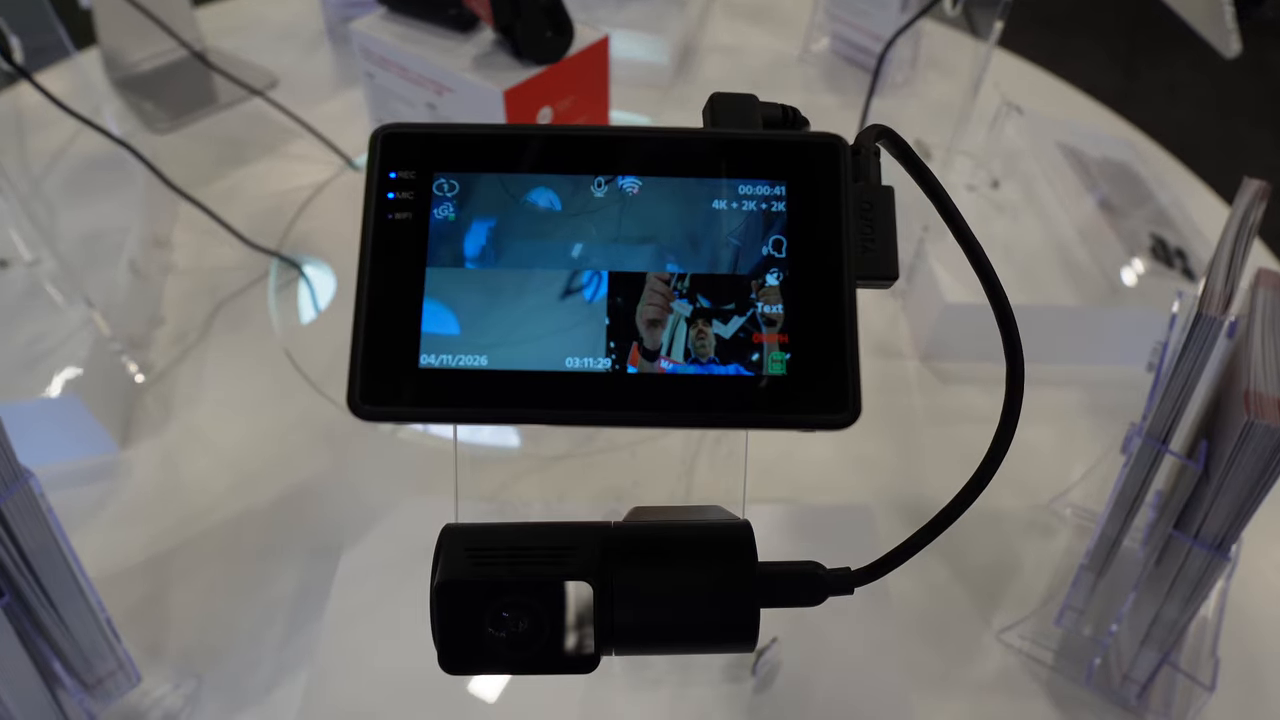
This was being shown as an upcoming product. My expectation was a possible 2027 arrival, but that wasn’t a confirmed release date.
The combination of an integrated telephoto camera and a touchscreen makes it one of the more interesting VIOFO products to test when it becomes available.
Other VIOFO Products on Display
The rest of the booth included a mix of recent and existing products:
- T330: It had been out for roughly a month, initially available directly from VIOFO, with retailers expected to receive it gradually.
- T340: A four-channel camera system.
- BP60: A battery pack we had already included in a comparison with the BP100.
- A229-series cameras: Existing products, including the Plus and Pro models.
The Z320 was the main new surprise. The other displays were useful for seeing the range together, but they weren’t all brand-new announcements.
BlackVue Elite 10 Cabin: 4K Front and 4K Interior
BlackVue’s booth was quieter in terms of new hardware. The Elite 10 and Elite 9 had already been around for a while, and the feedback I’d heard from testers was positive. That’s encouraging, although it isn’t a substitute for our own testing.
The new combination that stood out was the Elite 10 Cabin, pairing a 4K front camera with a 4K interior camera.
Do you need 4K inside the cabin? Personally, I’m not convinced everyone does. But if that’s specifically what you’re looking for, BlackVue now has that combination.
It’s another example of manufacturers expanding the camera configurations available, rather than treating every customer as someone who only needs front and rear road coverage.
What I’m Most Interested in Testing Next
The strongest ideas from SEMA 2026 were the ones tied to an actual installation or recording need.
DDPAI’s standalone interior camera answers a question we hear from customers. OVAMAN’s buffered parking recording could make an OEM-fit camera more useful. VUEROID’s Home Sync could simplify saving footage, while VIOFO’s Z320 adds another integrated telephoto option. The truck-specific systems are interesting too, provided they can stand up to everyday use.
But promising features still need testing. I want to see the footage, check parking-mode behaviour, verify compatibility, and find out whether these systems work as conveniently as their demonstrations suggest.
That’s the difference between an exciting dash camera specification and a camera I’d actually recommend installing.